

Brazil in Athens
Why there are bao buns on a South American menu
A Chinese bun, a Japanese Brazilian century and a menu that switches language halfway through a dish name. The honest answer to a fair question.
People ask about the bao. Not aggressively, but the question is there: this is a South American restaurant, so what is a steamed Chinese bun doing between the tortilla and the club sandwich?
It is a fair question and it deserves a straight answer rather than a story. The short version is that Brazil has had an Asian kitchen for over a century, that the bao itself is not part of that particular history, and that both of those things can be true at once without anybody having to pretend otherwise.
Where bao actually comes from
Bao is Chinese. The word covers a broad family of steamed buns, and the one that has travelled the world in the last fifteen years is the folded, clamshell sort, closest to the Taiwanese gua bao, which in turn descends from Fujianese cooking on the mainland coast.
Steaming rather than baking is the thing to notice. A baked bun sets a crust and holds its shape; a steamed one stays soft the whole way through and has almost no structure, which is why it wants a filling that is rich or crisp enough to give it some. That is a technical constraint and it explains most of what ends up inside one anywhere in the world.
Brazil had an Asian kitchen before most of Europe did
In 1908 a ship called the Kasato Maru docked at the port of Santos carrying the first organised group of Japanese migrants to Brazil. What followed was one of the largest migrations of its kind anywhere, and today Brazil has the largest population of Japanese descent outside Japan, concentrated in Sao Paulo.
That is not a footnote in Brazilian food, it is a structural fact about it. Soy, ginger, raw fish, rice technique and the whole vocabulary of a Japanese kitchen have been part of ordinary Sao Paulo cooking for generations, which is exactly how Brazilian sushi came to exist as its own tradition rather than as an import.
Chinese migration to Brazil is older still and smaller, and it left its own marks, particularly in Sao Paulo and Rio. So an Asian ingredient on a menu in Brazil is not a novelty and has not been for a hundred years.
So is a bao bun Brazilian? Honestly, no
Here is where it would be easy to overclaim, so we will not. The bao did not arrive in Brazil on the Kasato Maru and it is not a Japanese Brazilian dish the way a Sao Paulo sushi roll is. It reached Brazilian menus at roughly the same moment it reached London, Athens and everywhere else: in the 2010s, through the global street food wave, from Taiwanese and Chinese cooking.
What is genuinely Brazilian is the readiness to take it. A kitchen whose cooks already work with soy and ginger and steam every day does not have to stretch to put a bao on the menu. The technique was already in the building.
That is the honest answer. It is not ancestral, it is compatible, and compatible is a real thing rather than a consolation prize. Most of what people call national cuisine started as something compatible that stayed.
And to be exact about this restaurant rather than about Brazil: the menu here is South American fusion, not Brazilian. Brazil is the strongest single thread running through it, but it sits alongside Peru, Mexico and Argentina and a sushi counter, which is why a bao raises fewer eyebrows here than it would in a churrascaria.
The two on our list, and the language they are written in
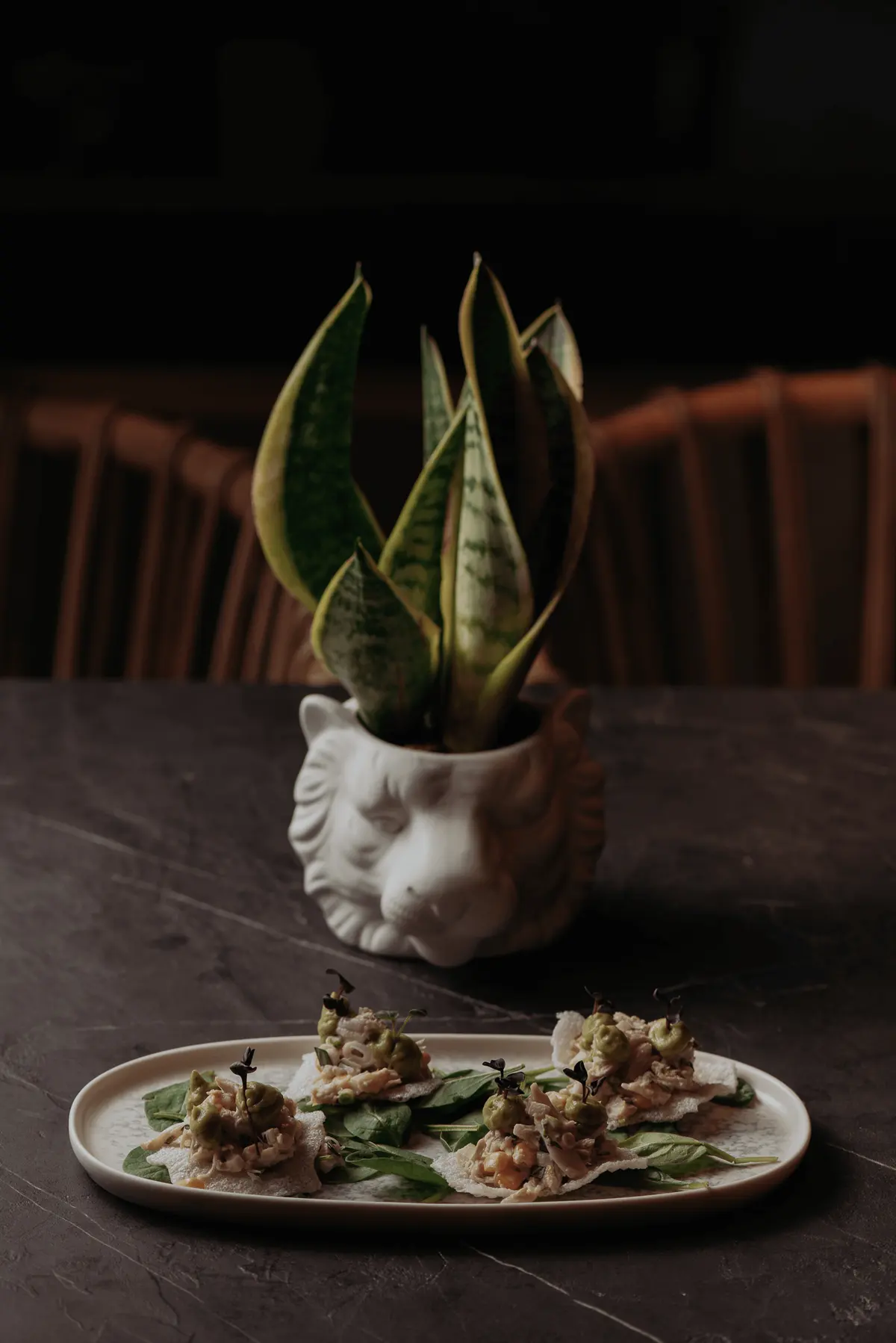
There are two, in the snacks section. Bao-bun de pollo and Bao-bun de Camarao, chicken and crispy shrimp. They sit with the tortilla, the pizza tropical, the chiapatta and the club sandwich, which is to say in the part of the menu that is deliberately not trying to be regional at all.
Look at those two names again, though, because they are doing something worth noticing. Pollo is Spanish. Camarao is Portuguese. Two dishes, side by side, in two different languages, and nobody in the kitchen thinks this is odd. That is not sloppiness. It is what an actual pan Latin American kitchen sounds like from the inside, where Spanish and Portuguese sit in the same sentence the way they do across most of the continent's borders.
They are also the thing people order twice, which is the most reliable review a dish can get. They turn up during the day alongside the eggs and the bowls, so they work as a brunch plate as easily as they work at midnight, and they are the least serious thing on the list in the best sense. If you cannot decide between them, order both and let the table settle it. The shrimp usually wins, though the chicken has its defenders among the people who work here.
Frequently asked questions
- Are bao buns Brazilian?
- No. Bao is Chinese, and the folded style most restaurants serve is closest to Taiwanese gua bao. It reached Brazilian menus in the 2010s along with everywhere else. What is Brazilian is having a kitchen already fluent enough in Asian technique to take it on without effort.
- Why does a South American restaurant serve them?
- Because Brazil has had an Asian kitchen for over a century. Japanese migration from 1908 made Sao Paulo home to the largest Japanese-descended population outside Japan, and soy, ginger and steam have been ordinary Brazilian ingredients ever since.
- What bao do you have?
- Two, in the snacks section: Bao-bun de pollo, with chicken, and Bao-bun de Camarao, with crispy shrimp. They are on during the day as well as in the evening.
- Why is one name in Spanish and the other in Portuguese?
- Because the kitchen is pan Latin American rather than specifically Brazilian, and both languages are native to it. Pollo is Spanish, camarao is Portuguese, and nobody who works here finds that strange.
- Are the bao buns spicy?
- Not by default. If heat matters to you in either direction, say so when you order and the floor team will tell you what is in each one.